Passive learning
Visual Memory for Language Learning
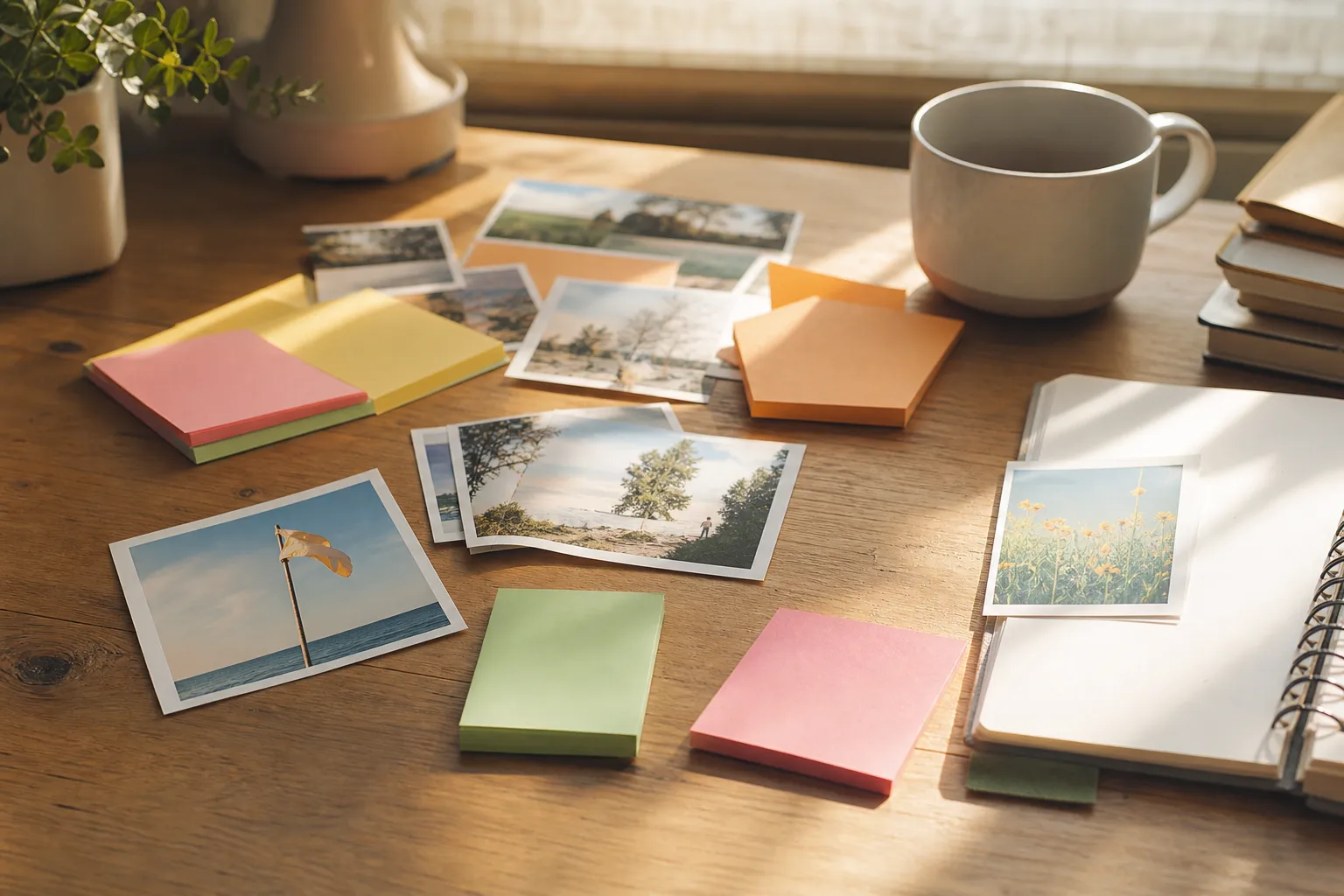
Visual memory leverages dual coding: verbal information plus images encodes stronger traces than words alone. For Spanish learners, pairing color-linked tokens, scene images, and audio gives three anchors for one phrase. That is why picture-backed modules outperform plain word lists for many beginners—you are not memorizing; you are recognizing a situation you have seen and heard repeatedly. Color bridges can mark gender, role, or translation alignment without grammar lectures. Use visuals as meaning bridges, not decoration. Snap a photo of your real kitchen and label three objects in Spanish tonight—memory loves your actual life.
Dual coding in plain terms
Brain stores word and image separately but linked. Recall one cue, get the other free—useful under stress.
Color as meaning bridge
Consistent color pairs for Spanish-English tokens speed scanning and reduce translation hop. Slapp uses this deliberately.
Scene images beat stock photos
Coherent mini-stories beat random clip art—context groups vocabulary naturally.
- Image + audio + text together
- Repeat same scene
- Colors as alignment cues
- Avoid text-only marathons
Limits of visual memory
Images help concrete nouns and actions more than abstract grammar. Still need audio for prosody.
Visual learner myths
Learning styles are oversimplified—but many adults benefit from visuals even if not “visual learners.”
DIY visual methods
Sketch stick figures for phrases. Label home with photos. Not required if app scenes suffice.
Slapp color method
Treat colors as alignment rails between languages while ears learn sounds—reduce cognitive load early.
Sketching scenes yourself
After a module, draw four stick figures with speech bubbles in Spanish. Ugly drawings memorable.
Color-code notebook: green Spanish side, blue English side—mimics app method on paper.
Photograph real locations matching scene vocabulary—your café photo beats stock image for memory.
Memory palaces for travelers
Link ten phrases to ten locations on your trip route—airport, hotel desk, metro turnstile. Walk the palace mentally nightly.
When visuals distract
If images clutter, switch to audio-only week. Visuals help many, not all. Personalize modality without guilt.
Photo your own scenes
Snap your real café counter; label photo with Spanish lines you will say there tomorrow.
Pictures anchor sound
Image plus audio plus text encodes stronger than words alone in lists or cards. Color and layout speed scanning without grammar lectures that interrupt the story.
Sketch stick figures after a module—ugly drawings are memorable because effort tags memory and gives you a private joke to recall later.
Match visuals to situations you will meet: café, metro, hotel desk. Abstract clipart wastes the channel and does not survive the first real trip abroad.
Say the scene line while looking at the image, then look away. Dual coding checks whether the picture still pulls the sound up.
Fade support deliberately
When audio alone recalls the scene, hide images for a week test and notice whether recall holds. Modality is personal, not moral.
If visuals clutter, simplify before abandoning them entirely. One strong image beats six busy icons competing for attention on a small phone screen.
Visual memory helps beginners most at the start. Advanced weeks may lean ear-heavy—and that is fine as long as comprehension stays calm.
Close your eyes mid-scene occasionally. If you still follow, the image did its job and can step back.
Color-code a paper phrase list
Green pen Spanish, blue pen English on one sticky note per phrase. Mimics Slapp alignment without opening the phone when batteries die.
Examples
Veo la escena y recuerdo.
I see the scene and remember.
El color me ayuda.
The color helps me.
Imagen y sonido juntos.
Image and sound together.
No solo palabras sueltas.
Not just loose words.
FAQ
Do I need pictures as an adult?
Often helpful regardless of age—dual coding is not childish.
Flashcards with images?
Better than text-only cards; still weaker than full scenes with audio.
When to drop visuals?
Gradually as audio alone suffices—no rush to abandon support early.
Takeaway
Let images and color align with audio so phrases lodge in memory as scenes—not as isolated translations. Images help when paired with audio—sight alone is half a memory bridge. Sketch ugly stick figures; memory cares about meaning, not art. Use images to lock sound and meaning, then lean on audio as scenes graduate.