Culture
Common Spanish Gestures
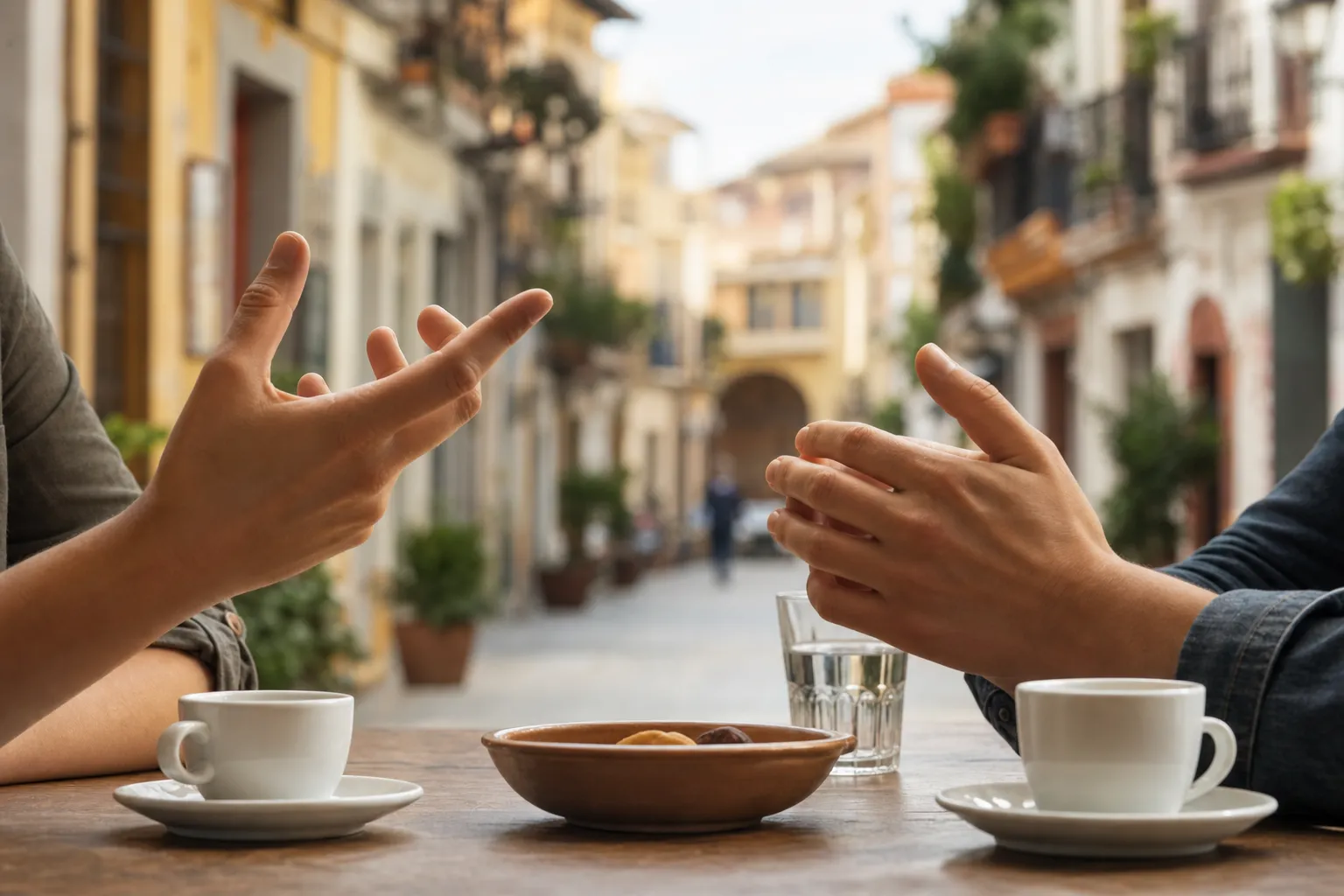
Spanish-speaking cultures communicate with hands as much as mouths. Gestures can reinforce politeness—or cause offense when copied without context. English-speaking tourists should observe before performing: the same hand flip can mean “come here” in one country and feel rude in another. Pair body language with simple spoken phrases so you are not silent and ambiguous. Gestures supplement language learning; they do not replace please, thank you, and clear speech. Film yourself ordering in Spanish without gestures, then with—notice how hands help meaning when vocabulary is thin.
Why gestures matter for learners
Watching hands helps comprehension in noisy bars and streets. Natives expect some kinetic politeness—eye contact, nodding, appropriate distance.
Common gestures you will see
Pinching fingers for delicious (chef’s kiss variant). Index finger side of nose for watch out/clever. Open palm down for calm down/wait. Beckoning with palm down in parts of Latin America.
Spain versus Latin America differences
Beckoning, pointing, and “okay” hand signs vary. When unsure, use words instead of guessing.
- ¡Qué rico! + gesture — delicious
- Mano abajo — wait/calm
- Señalar — pointing (use cautiously)
- Besos — cheek greetings in many regions
Gestures tourists should avoid
Obscene signs from movies. Mocking local gestures. Aggressive pointing at people.
Greeting gestures and personal space
Cheek kisses, handshakes, or hugs vary by country and gender norms. Follow the host’s lead; hesitation is okay.
Learning by observation
Watch street interviews and sitcoms with attention to hands. Pause and describe gestures in English to lock memory.
Pair words with gestures
Say gracias with nod. Say un momento with raised finger. Speech plus gesture reads as culturally aware.
Filming yourself to reduce gesture errors
Record a two-minute Spanish self-intro watching only your hands. Compare to native interview clips.
Practice ordering coffee with hands still—verbal clarity first, gesture second.
In business meetings, neutral hands on table reduces accidental misreads across cultures.
Filming locals and gesture context
Recording street scenes for learning is fine; mocking gestures on social media is not. Ethics part of cultural study.
Gestures with masks or sunglasses
Half the face hidden—rely more on verbal please/thank you to compensate lost facial cues.
Gestures with masks and distance
COVID habits changed cheek kisses in some regions—offer a wave if unsure. Verbal warmth compensates.
Point with open palm, not finger, when asking directions—small courtesy visible to locals.
Gestures tourists misread
A palm-down finger wave means “come here” in much of Spain and Latin America; a single upward finger beckon can read as rude in several countries. When unsure, use words—¿Puede venir un momento?—and skip guessing.
Touching your elbow with a closed fist while eating signals delicious in some regions; the Italian-style chef’s kiss appears too. Pair gestures with ¡Qué rico! so meaning is clear if your hands confuse more than help.
The “lots” gesture—thumb to fingers flicking—varies in intensity. Context and facial expression carry the difference between “a little” and “a lot.” Watch locals in markets before copying hand shapes from a phrasebook illustration.
Greeting touch norms
Cheek kisses range from one to two depending on country, city, and gender norms. Follow the host’s lean-in; hesitation is fine on first meetings. Handshake plus mucho gusto remains safe in offices and formal introductions.
Personal space is smaller in many Latin cultures than in northern Europe or the US. Stepping back abruptly can seem cold; a light shoulder pat among friends is common where you might only nod at home.
Pointing at people is generally softer than in Anglo cultures but still worth avoiding. Use open-hand indication toward a seat or menu item. Polite speech plus neutral hands beats animated miming alone.
Examples
¡Qué rico!
How delicious! (often with gesture)
Un momento, por favor.
One moment, please.
Así, ¿verdad?
Like this, right?
Ven acá, por favor.
Come here, please. (say it, do not only beckon)
FAQ
Is the okay sign safe everywhere?
In some regions it is offensive. Prefer thumbs up sparingly or just speak.
How many cheek kisses?
Varies: one, two, or none. Mirror locals.
Do gestures count as slang?
They are cultural paralanguage—learn with observation, not textbooks alone.
Takeaway
Watch hands, speak simple phrases, and copy gestures only when you understand the context. Body language is regional—not universal Spanish. Body language is regional, not universal Spanish—watch hands, speak simple phrases, and follow the host’s lead.